Do Bugs Have Higher Brain Function Than Babies
'Problems Brain Soup' Expands Menu for Scientists Studying Animal Brains
Past mashing up brains from various insect species, neuroscientists at the University of Arizona innovate a practical technique for quantifying the neurons that make up the brains of invertebrate animals. In addition to revealing interesting insights into the development of insect brains, the work provides a more meaningful metric than traditional studies measuring brain size or weight.
By Daniel Stolte, University Communications
April 7, 2021

Using a surprisingly simple technique, researchers in the University of Arizona Department of Neuroscience take succeeded in approximating how many brain cells make upward the brains of several species of bees, ants and wasps. The work revealed that sure species of bees have a higher density of brain cells than even some species of birds, whereas ants turned out to accept fewer brain cells than originally expected.
Published in the scientific journal Proceedings of the Purple Lodge B, the study marks the kickoff time the new cell counting method has been practical to invertebrate animals and provides a robust and reproducible protocol for other research groups studying the brains of invertebrate animals.
For more than than a century, scientists have attempted to measure and compare the brains and brain components of vertebrates across species in efforts to draw conclusions about how brains support the animals' behavioral and cognitive abilities and ecological requirements. Theories of cognitive capacities of brute brains, including those of fossilized remains of the evolutionary ancestors of humans, are based on such measures.
To that end, scientists need to know how many neurons make up a given brain. Until recently, information technology was extremely tedious and time-consuming to count or estimate the number of neurons in a brain, even with reckoner and software-based systems.
For this reason, there were very few reliable neuron numbers bachelor for any animals, including the human brain. Instead, brain researchers relied on estimates and extrapolations based on measurements of brain size or mass. Merely that approach can be fraught with uncertainties and biases, according to the authors of this study. For case, while larger animals, equally a general rule, tend to have larger brains than smaller animals, the book and mass of a given brain solitary don't say much about its cognitive capabilities.
"How large or how heavy a encephalon is does not give you the best measure of an animal's cognitive capabilities," says the study's atomic number 82 author, R. Keating Godfrey, a postdoctoral researcher in the Department of Molecular and Cellular Biology.
Why 'Bird Brain' Is Actually a Compliment
One major reason is that the size of a brain is less relevant for its processing capacities compared with the number of neurons, or nervus cells, information technology contains. This is coordinating to the processing ability of a computer, which has little to exercise with the physical size of its central processor. Neurons are highly specialized types of cells establish in virtually any species across the animal kingdom.
Contrast, for case, the sea hare – a behemothic body of water slug found off the coast of California that can weigh more than than 12 pounds – with the fruit fly Drosophila. The sea slug'south brain solitary dwarfs the entire wing by a lot, yet it has just 18,000 neurons, far fewer than the wing's approximately 100,000.
"Just because the brain of one species may exist 10 times larger than that of another does not mean it has 10 times as many neurons," says the paper'southward senior author, Wulfila Gronenberg, a professor of neuroscience who heads a Department of Neuroscience research group defended to unraveling the mysteries of insect brains.
Whereas "bird brain" is widely used as a derogatory term for a lack of intelligence, information technology really is a misnomer, Gronenberg says.
"Bird brains have many more neurons than a typical mammal of comparable size," he says. "Birds take to navigate a three-dimensional space past flight, and in club to get all that processing power into a small, lightweight package, their neurons are smaller and more densely packed."
Social Brains
Gronenberg's research group is interested in the neuronal underpinnings of insects that alive in social communities, like honeybees or many wasps.
"We wanted to know: Is in that location something special near the brains of social insects?" Godfrey says.
Specifically, she and her colleagues set out to study whether the "social encephalon" hypothesis, which was developed for vertebrate animals and postulates that the size of a brain or particular brain region is correlated with social group size and grouping behaviors, also holds true for social insects.
With the assist of undergraduate students, Godfrey worked on adapting a technique – adult in 2005 by Brazilian neuroscientist Suzanna Herculano-Houzel that revolutionized the field of vertebrate neuroscience – to the insect brains. Instead of slicing brains into hundreds or thousands of sparse sections and counting neurons in each section, the method requires merely that the encephalon tissue is homogenized. That's science speak for "blended," which results in a encephalon soup.
"We release the nuclei from the cells and then nosotros can count them," Godfrey says. "Vertebrates have defended brain regions and structures that you can sample from, but in insects, we can just really squish the whole thing. And then we become a neuron density count for the entire brain."
Godfrey and her co-authors compared the encephalon jail cell counts with the body sizes of a big range of hymenoptera – bees, wasps and ants – and institute that the neuron number and brain size relationships are very like to those found in vertebrates.

Putting a Number on an Pismire Brain
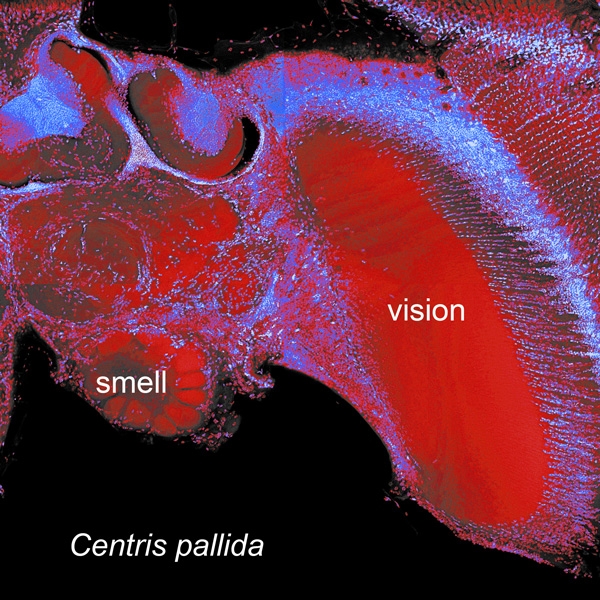
Certain bees, the team reports, have particularly high numbers of neurons, which should stimulate renewed research into their behavioral capacities, and ants, in general, have fewer neurons than their wasp and bee relatives, probably because they exercise not fly and thus need less brain ability for visual processing and flight command.
Some bees, information technology turned out, have fifty-fifty higher brain jail cell densities than some of the virtually compact bird and mammal brains. For example, the metallic light-green sweat bee, which is commonly seen in the Southwest and belongs to the genus Augochlorella, has a particularly high number of neurons for its brain size: about 2 1000000 per milligram, more than the highest neuron densities found in the smallest vertebrate species – smoky shrews in mammals and goldcrests in birds.
Ants, on the other hand, tended to come up in on the lower terminate of the spectrum. Compared with bees and wasps, ants had small brains and relatively few encephalon cells. A desert harvesting emmet species common in Arizona amounted to simply 400,000 cells per milligram of brain mass. Considering that this ant's encephalon weighs in at less than 1 milligram, this beast makes do with a total of 90,000 or so brain cells, Gronenberg estimates.
"We recall this has to do with the ability to fly, which would arrive less about intelligence but more near processing of data," he says. "Ants rely on scent information, whereas bees rely more on visual information."
How Depression Tin You Become?
These findings beg the question of how many brain cells nature needs to brand a functioning encephalon. Invertebrate brains tend to have highly specialized neurons, each performing a certain chore, co-ordinate to the authors of the report, which allows them to reach tasks with a small brain and a small number of neurons.
Gronenberg points to the tiny fairy wasp as a strong contender for the "tiniest brain in the insect world" award. Iii strands of human hair, laid side by side, would cover the body length of the tiny animal, whose brain consists of fewer than 10,000 neurons.
"Yet, this parasitic wasp can practice all the things it needs to do to survive," Gronenberg says.
"It tin detect a host, it tin mate, information technology can lay eggs, it tin walk and information technology can fly," he says. "While a small insect may simply take one or a few neurons to perform a item office, humans and other vertebrates tend to accept many thousands, or even tens of thousands, of these specialized neurons dedicated to one task, which allows the states to exercise things more than precisely and in a more than sophisticated manner."
The inquiry paper was co-authored by Mira Swartzlander, who participated in the work in Gronenberg's lab as role of the KEYS Research Internship Program, a summer research opportunity for high school students offered past the UArizona BIO5 Institute.
This work was supported past the National Scientific discipline Foundation (grant number ISO-1354191) and a fellowship from the university'due south Graduate Interdisciplinary Plan.
Share
derricksoncamedid.blogspot.com
Source: https://news.arizona.edu/story/bug-brain-soup-expands-menu-scientists-studying-animal-brains
0 Response to "Do Bugs Have Higher Brain Function Than Babies"
إرسال تعليق